
Pressurised equipment keeps flammable gas out by holding a protective gas inside the enclosure above outside pressure.
Introduction #
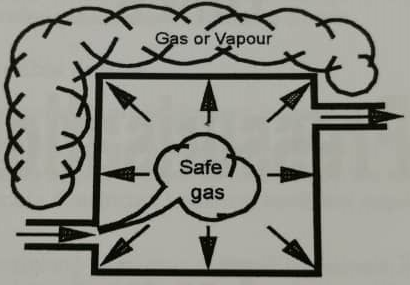
Pressurisation is a simple explosion protection technique. If the interior of an enclosure is at a pressure slightly above that externally, any flammable gases around the enclosure will be prevented from entering the enclosure.
Components which are a source of ignition, (produce arcs/sparks or hot surfaces) are permitted within the enclosure. Safety is dependent on the maintenance of the safe gas.
The safe gas is the medium which ‘segregates’ the flammable gas from the source of ignition, and its continued presence will be confirmed by a certified control/monitoring system.
In the standard for this type of protection, IEC 60079-2, there are three types of pressurisations, px, py and pz.
Standards #
| Current constructional standards | |
| IEC 60079-2: 2014 BS EN60079-2: 2014 | Explosive atmosphere – Part 2: Equipment protection by pressurised enclosures ‘p’ |
| IEC 60079-13: 2010 BS EN60079-13: 2010 | Explosive atmospheres – Part 13: Equipment protection by pressurized room “p” |
| Codes of Practice | |
| IEC 60079-14: 2013 BS EN60079-14: 2014 | Explosive atmospheres: Part 14 Electrical installations design, selection & erection |
| IEC 60079-17: 2013 BS EN60079-17: 2014 | Explosive atmospheres: Part 17 Electrical installations inspection and maintenance |
Definition #
Pressurisation is defined as the technique of guarding against the ingress of the external atmosphere into an enclosure by maintaining a protective gas therein at a pressure above that of the external atmosphere.
Zones of use: Depending on the type, pxb, pyb or pzc (px,py & pz in the previous edition of 60079-2), pressurisation may be used in Zones 1 & 2, or locations that require EPL Gb (ATEX Cat.2) or Gc (Cat.3).
Key points about pressurised equipment #
Pressurised equipment is one of the most versatile protection methods, because almost any enclosure can be protected if it is strong and well sealed. The three types differ in what they achieve. Type px makes the inside of a Zone 1 enclosure non-hazardous, py reduces it to Zone 2 conditions, and pz makes the inside of a Zone 2 enclosure non-hazardous.
Safety depends entirely on the protective gas and its monitoring. Therefore every installation needs a purge cycle before energising, continuous pressure and flow monitoring, and a defined action on loss of pressure. Pressurised rooms, covered by IEC 60079-13, apply the same ideas to whole buildings such as control rooms on offshore installations.
Start with principles of pressurisation, then read types of pressurisation and purging. The standards for pressurised equipment are published by IEC.


