
ApplicationsClear seawater lift, cooling and fire water.
In offshore oil and gas, fouling in seawater lift, cooling and fire water systems reduces flow and risks firewater availability.
Recommended
- ECHLOR
- ECHLORX for hazardous areas
OverviewBiofouling control for offshore oil and gas
Every platform, FPSO and FSO depends on seawater. Lift pumps feed the cooling water system, the firewater ring main, the deluge system and often water injection. Mussels, barnacles and slime settle in caissons, strainers, heat exchangers and pipework within weeks, and once they take hold they cut flow, raise pump load and can leave firewater pumps short of capacity when they are needed most.
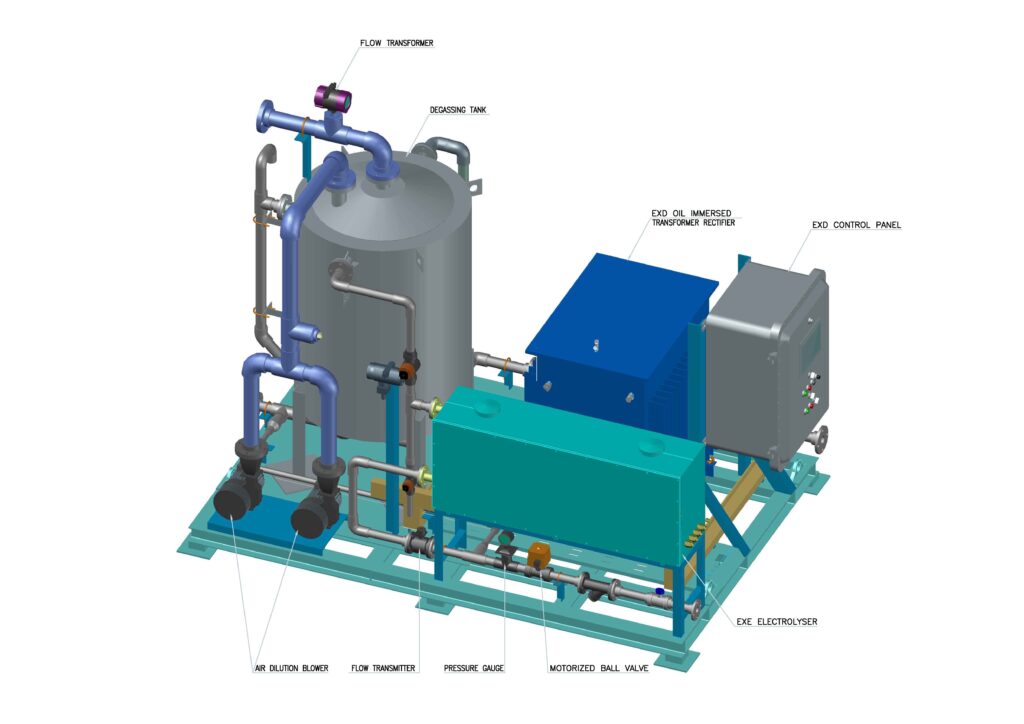
Electrochlorination is the standard answer in offshore oil and gas. An ECHLOR seawater electrochlorination package draws a small side-stream of seawater, passes it through an electrolyser and doses the sodium hypochlorite it makes back into the pump caissons and intakes. A continuous low dose stops larvae settling, and periodic shock dosing keeps the system clean. Nothing is shipped offshore, stored or handled by the crew.
Where the package sits in a hazardous area, ECHLORX is certified IECEx Ex eb ib IIC T6 Gb for Zone 1, so the electrolysers and control panel can be installed close to the lift pumps. Hydrogen produced in the cells is separated and vented safely, and the rectifier can be supplied as an explosion-proof rectifier.
Offshore operators also use AZUVIA offshore ICCP to protect jackets, hulls and subsea structures from corrosion. Fouling control and cathodic protection are both written into the IMO biofouling guidance and class rules that most offshore oil and gas assets follow. Send us your seawater flow, location and area classification and we will size a system for your field.
Tell us what's possible.
Send us your duty, feedwater and location. An AZUVIA engineer will reply.