
Marine Growth PreventionProtection where the sea chest won't take anodes.
Anodes are fitted in a compact housing at the pump or strainer. It suits vessels and plants where the sea chest is hard to reach or too small.
MGPS for seawater lift pumps
System OverviewPurpose designed anode units for offshore platforms and semi-submersible rigs.
- Proven effectiveness in eliminating bio-fouling.
- Automatic in operation – requires minimal attention.
- Safe and environmentally friendly
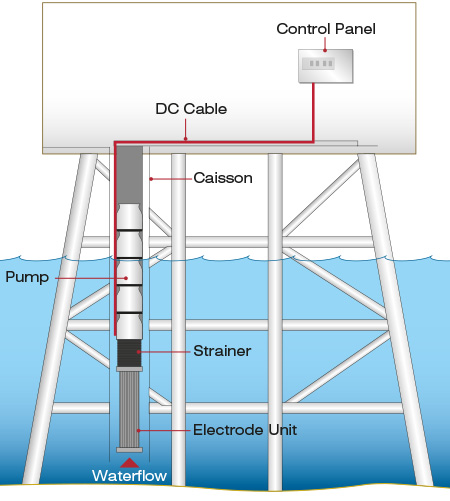
Anode units for semi-submersible rigs
Pump protection
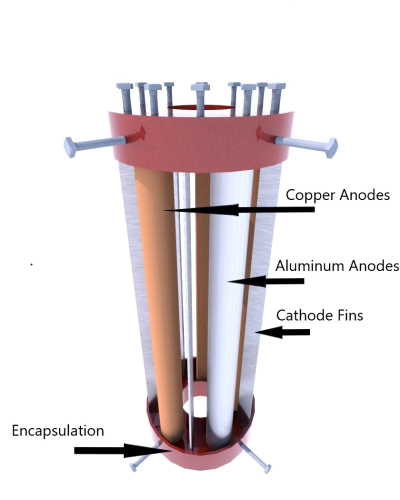
Pump protection antifouling units are designed to be mounted at the bottom of pumps, often inside the stilling tube or caisson. They consist of special copper and aluminium anodes housed within a steel framework and fed with an electrical current from a control panel. The anode mounting frame acts as the cathode, creating a completely self contained unit which is electrically isolated from the pump using a specially designed isolation unit.
Anode units for semi-submersible rigs
Pump protection units
OverviewWhere pump-mounted MGPS fits best
Some vessels and platforms have no room for anodes in the sea chest. Others draw seawater through deep caissons. In both cases, pump-mounted MGPS is the practical answer.
The anodes sit in a frame at the pump inlet. Therefore, the protective ions enter the water exactly where it starts its journey. The frame also acts as the cathode, so the unit is self-contained.
A panel controls the current to each anode. Because the dose follows the set current, it stays steady day and night. Meanwhile, the crew only needs to check the panel and replace anodes at docking.
Pump-mounted MGPS suits semi-submersible rigs, jack-ups and platforms with caisson pumps. It also suits plants with deep intakes. For sea chests with space, however, a standard MGPS is often simpler.
We supply new units and replacement anodes for most makes. Good fouling control also supports the IMO biofouling guidelines. Tell us your pump size and flow, and we will propose a pump-mounted MGPS.
Tell us what's possible.
Send us your duty, feedwater and location. An AZUVIA engineer will reply.