
Pressure piling occurs when an explosion pre-compresses gas in another part of an enclosure, causing a much higher secondary pressure.
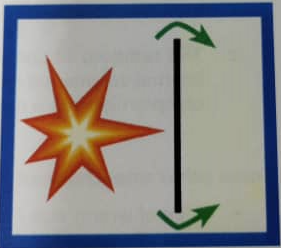
If a flammable mixture is compressed prior to ignition, the resulting explosion pressure will be considerably higher than if the same mixture was ignited at normal atmospheric pressure.
Pressure piling can occur as a result of sub-division of the interior of a flameproof enclosure, which prevents the natural development of an explosion.
An explosion at one side of an obstacle pre-compresses the flammable mixture at the other side, resulting in a secondary explosion that can reach an explosion pressure around three times that of the initial explosion.
To prevent pressure piling, manufacturers must ensure that in any cross-section within an enclosure, there is adequate free space around any potential obstruction, which may be a large component or a number of components (typically 20-25% of the total cross-section).
How designers prevent pressure piling #
Pressure piling is one reason why flameproof enclosures must not be modified. A component added in the wrong place can split the enclosure into compartments. When gas ignites in one compartment, the flame front pushes unburnt gas into the next, compressing it before it ignites. The second explosion can then reach around three times the normal pressure, which may exceed the enclosure’s design strength.
Manufacturers avoid this by keeping free space around components, typically 20 to 25 percent of any cross-section, and by testing the complete enclosure with its components fitted. Certification then fixes that layout. As a result, replacing a component with a larger one, or adding parts, can create pressure piling that the original tests never covered.
For users, the lesson is to keep the internal layout exactly as certified. For more detail, read modification of flameproof enclosures and flameproof enclosure construction. Flameproof design is covered by IEC 60079-1, published by IEC.


