
Obstruction to flamepaths can stop a flameproof joint cooling escaping gases, so minimum clearances apply.
IEC / BS EN60079-14 states that the obstruction of flanged joints must be avoided, unless the equipment has been tested at smaller distances than those shown in the table below.
A solid object such as a wall, steelwork, conduit, bracket, or other equipment etc., in close proximity to the opening at the joint can, in the event of an internal explosion, reduce the efficiency of the flamepath to the extent that ignition of the external gas could occur.
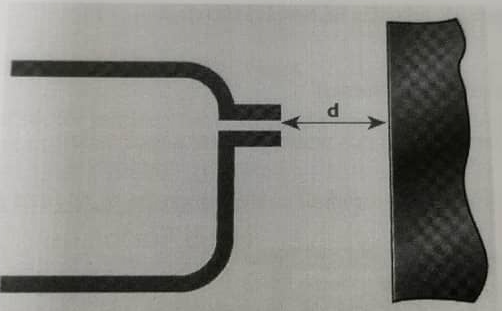
The minimum separation distances between the flamepath opening and an obstruction, as specified in 60079-14 are:
| Gas Subdivision | Distance |
| IIA | 10mm |
| IIB | 30mm |
| IIC | 40mm |
Keeping flamepaths clear #
A flamepath works by cooling hot gases as they squeeze out through a long, narrow gap. If a solid object sits close to the outlet, the escaping gases cannot spread and cool, and they may stay hot enough to ignite the surrounding atmosphere. That is why the standard sets minimum distances: 10 mm for IIA, 30 mm for IIB and 40 mm for IIC.
These distances apply to walls, steelwork, cable trays, brackets and neighbouring equipment. They are easy to infringe during installation or later modifications, for example when a new cable tray is added close to an existing enclosure. Unless the manufacturer has tested the equipment at smaller distances, the clearances must be respected.
During inspection, check flanged joints for nearby obstructions, as well as for paint, corrosion or damage. For more detail, read flameproof enclosure construction and ingress protection methods. The rules are set out in IEC 60079-14, published by IEC.


