
The principles of pressurisation rely on keeping an enclosure slightly above outside pressure so flammable gas cannot enter.
The basic principle of operation involves raising and maintaining the internal pressure of the enclosure to a level slightly above the atmospheric pressure outside the enclosure. This ensures that any flammable gases or vapours cannot enter. The minimum over-pressure specified in standards is 50 Pa (0.5mBar) for types px and py, and 0.25mBar for type pz.
The safe gas used to provide the over-pressure will normally be air, but an inert gas such as nitrogen may also be used where necessary
Note: The manufacturer shall specify the minimum and maximum normal overpressure in service, the maximum overpressure during purging and the maximum leakage rate at the maximum normal overpressure.
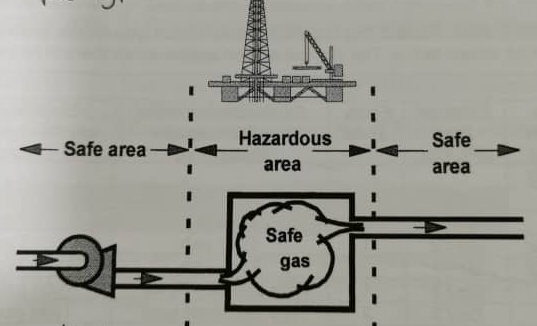
Applying the principles of pressurisation #
The principles of pressurisation are easy to state but demand careful design. A small overpressure of 50 Pa for px and py, or 25 Pa for pz, is enough to stop gas entering, provided it is maintained at every point in the enclosure. Leaks, open doors and blocked ducts all threaten that margin, so monitoring is essential.
Pressurisation has big advantages. It lets ordinary industrial equipment, such as drives, PLCs and analysers, operate in a hazardous area without being individually certified. It also suits very large items, from motors to whole control rooms, where flameproof enclosures would be impractically heavy.
The price is reliance on a working protective gas supply and control system. Read types of pressurisation, purging and loss of pressure to complete the picture. Pressurised equipment is certified through the IECEx scheme.


