The DC current requirement of an electrolyser follows from the amount of chlorine it must produce and its current efficiency.
Central to the design of an ECP are the fundamentals of Electrochemistry as related to producing a given weight of Chlorine. To produce a given weight of Chlorine it is necessary to pass a quantity of DC electricity through a suitable electrolyte and the necessity is to calculate the power requirements and Electrolyser configuration to achieve that requirement.
The calculation to determine the current required to pass through a single electrolytic cell when a potential difference (Voltage) is applied to the Anode and Cathode of that cell is as follows
From Faradays laws of Electrolysis the Amperage required for the generation of a weight of Chlorine from a Sodium Chloride / Water solution would follow.
m = AQ
zF
Where
m = mass generated g
A = relative atomic mass of Chlorine z = Charge number Cl– =1 F = the Faraday Constant = 96,500 C
Q = quantity of electricity C
(C= 1 Coulomb = 1A/second)
Transposing the formula
Q = mzf
A
The data applicable to the process is shown in the following table
| Electrochemical Equivalent | Atomic Mass | Charge Number | |||
| Chlorine | Cl | 1.3228 | 35.4527 | 1 | – |
| Hydrogen | H | 0.37605 | 1.00794 | 1 | + |
Therefore applying the calculation to determine the theoretical amperage requirement at 100% efficiency for 1 g of Chlorine
Q = m z f
A
Q = 1 x 1 x 96500
35.4527
Q = 2721 C
Therefore
To produce 1g of Chlorine by electrolysis requires
2721 C(amp seconds)
3600
0.7558 A/h
Similarly the electrochemical equivalent can be used.
1
0.7558
= 1.3228
The Amp hours that have been calculated above are for a single electrochemical cell to which a potential difference has been applied.
Example 1 illustrates a capacity demand of 24.75kg/h which will be considered as being generated in a stream of 4 electrolysers.
Therefore
24.75 ÷ 4 = 6.19kg/h/Electrolyser
Therefore for this example
Amp/h = 0.7558 A/h x 1000 x 6.19
6.5kg Cl = 4678 Amp/h
This calculated value has to be subject to the Faraday efficiency attributable to the process, values can vary but are typically quoted in the range from 76% to 95% and are related to electrolyte composition and electrode materials. For this example 85% is chosen.
Therefore for 10kg/Cl from a single electrolytic cell
6.19 kg Cl = 4678 Amp/h
0.85
6.19 kg Cl = 5504 Amp/h
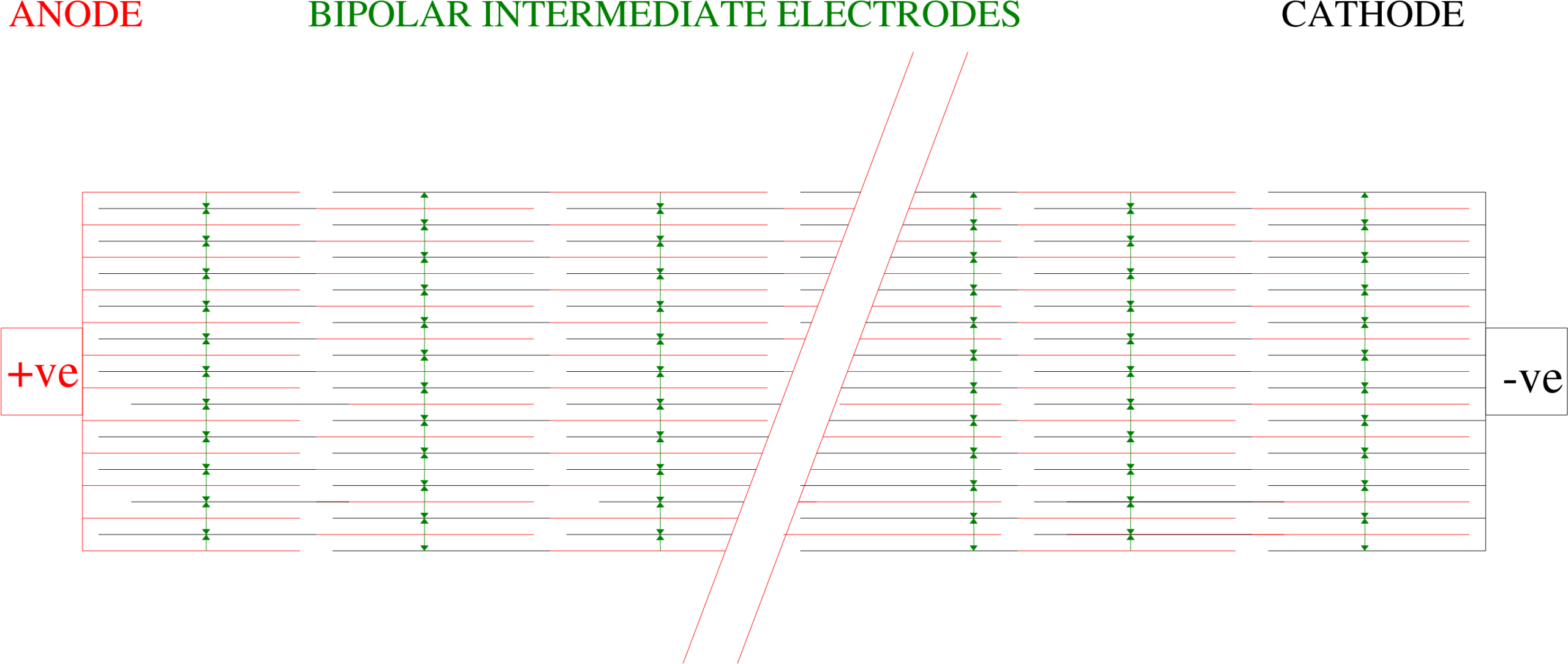
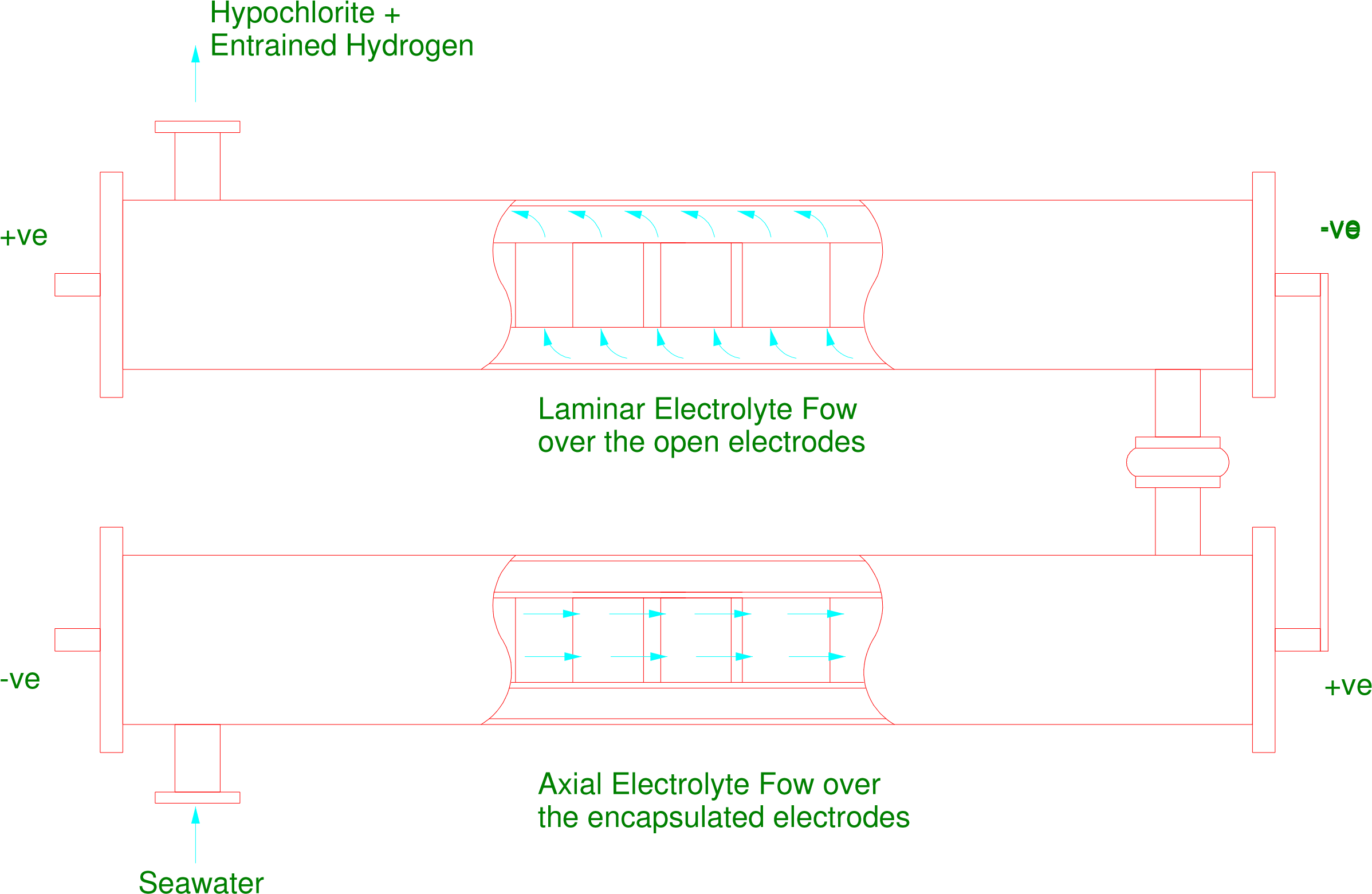
Parallel Plate Electrolysers typically consists of 10 Electrolysis Cells in electrical series, see illustrations below, therefore for 6.19 kg/Cl the amperage to be supplied to the Electrolyser stream would be
5504 ÷ 10 = 550.4 A (DC)
This would be the DC current supplied to the 4 x electrolysers in series to produce the weight determined in Example 1.
NB
A frequently asked question is whether the Sodium Hypochlorite produced by the electrolysis of a brine solution (Seawater) is a Chlorine equivalent. The forgoing calculation demonstrates that it is a direct equivalent.