
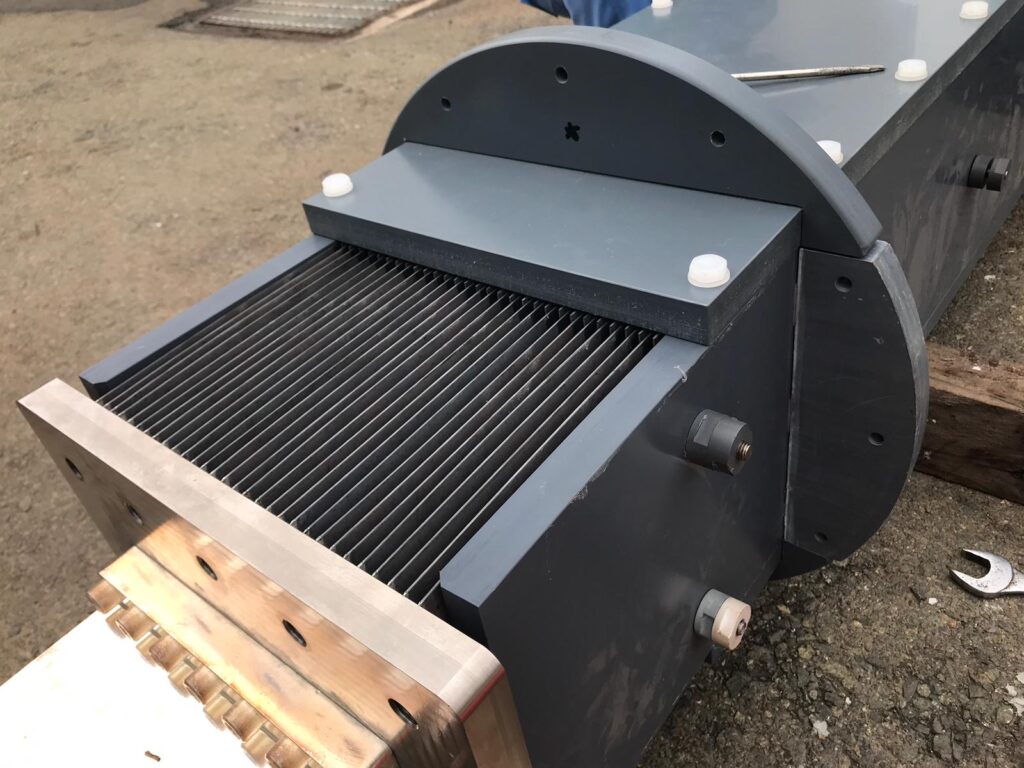
ECHLOR ElectrolysersMore hypochlorite from less floor space.
ECHLOR BPX stacks bipolar plates in a sealed housing, cutting busbar losses and power use per kilogram of chlorine. It mounts horizontally or vertically and suits the large flows of power plants and desalination intakes. At end of life only the inner electrode stack is replaced; the housing and pipework stay in place.
Best for
- Large onshore systems
- High-capacity offshore duties
ECHLOR PPE System provide incomparable biofouling control
System OverviewSimple and straightforward electrolytic process, combining two common consumables (seawater and electricity) to economically and safely generate critical sodium hypochlorite solution
Standard ECHLOR PPE systems range in capacity starting at 480 kg/day to 21,600 kg/day (1058 lb/day to 47,620 lb/day) per train with higher capacities achieved by adding trains.
ECHLOR PPE systems are designed and assembled for continuous and unattended operation requiring minimal monitoring. Typical transport and handling limitations have also been considered to minimize customer logistics.
- Preferred electrochlorination system for biofouling control
- Based on 90 years of electrochemical experience
- Effective and reliable treatment in hazardous marine/corrosive environments
- Easy operation and minimal maintenance
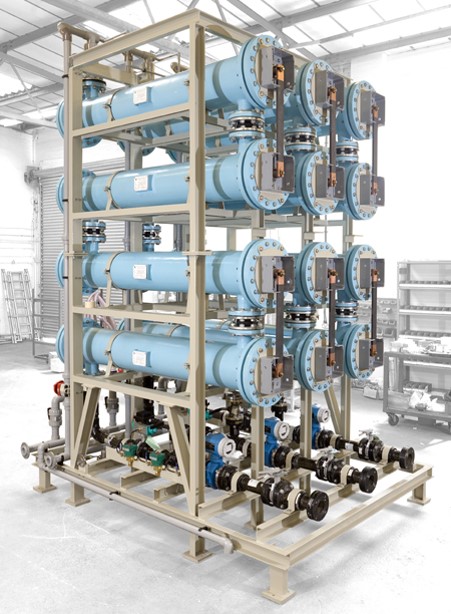
Parallel Plate Electrolyzer
Pressurized seawater, which can be supplied by AZUVIA, is delivered to the Electrochlorination system where it is strained to remove suspended solids larger than
0.5 mm. The seawater passes through a flow control assembly, which may include a flow control valve and a flow transmitter with local indication and low flow
shut-down protection. The seawater then passes through the electrolyzer cells and exits as sodium hypochlorite solution with the byproduct, hydrogen gas. This two-phase solution is piped to a tank or hydrocyclone where hydrogen gas is removed from the solution. The hydrogen is typically diluted with air using a set of redundant blowers to a safe level (typically less than 1% by volume which is 25% of the explosive limit). Finally, the sodium hypochlorite solution is injected at the required continuous and/or shock-dose rates.
Tell us what's possible.
Send us your duty, feedwater and location. An AZUVIA engineer will reply.